My mission at Google is to develop natural language understanding with a team and in collaboration with other researchers at Google. Search has moved beyond just finding keywords, but it still doesn’t read all these billions of web pages and book pages for semantic content. If you write a blog post, you’ve got something to say, you’re not just creating words and synonyms. We’d like the computers to actually pick up on that semantic meaning. If that happens, and I believe that it’s feasible, people could ask more complex questions.Wired Magazine article
Showing posts with label Robotics. Show all posts
Showing posts with label Robotics. Show all posts
Thursday, April 25, 2013
Ray Kurzweil Speaks About His Role at Google
Late last year, Google announced
that it had teamed up with AI guru Ray Kurzweil to collaborate on AI
applications both in search and elsewhere. Last week, Kurzweil hosted a
Google Hangout, and then sat for an interview with Wired Magazine. Among the highlights was his description of what he is doing for Google:


Tuesday, April 9, 2013
National Robotics Week Continues

National Robotics Week continues this week (and through April 14th, although events continue throughout the month of April.)
For more info see:
National Robotics Week website
Twitter: @roboweek
Facebook page
Monday, January 7, 2013
Audi Authorized by Nevada for Driverless Car

Friday, January 4, 2013
Obama Signs "Fiscal Cliff" Bill with Help of Robot
Having departed Washington shortly before midnight on January 1st to return to his family's vacation spot in Hawaii, President Obama nonetheless was able to sign the so-called "Fiscal Cliff" bill, thanks to a robotic autopen that has its roots in the Jeffersonian era. President George W. Bush's White House first asserted the legality of a President signing (of a law) via autopen, but did not use it; Obama became the first President to actually do so, first with the extension of the PATRIOT Act, and then again this week.
">National Journal article
Thursday, March 17, 2011
Reuters: Why no Robots in Japan's Nuke Facility?

[Cross-posted at ST-AIRC Blog)
Reuters is running a story wondering why Japan -- where robots are used much more extensively then in the US -- no robots are available to help solve the nuclear emergency at the Fukushima Dai-ichi plant.
Japan a Robot Power Everywhere Except at Nuclear Plant
By Jon Herskovitz
TOKYO, March 17 (Reuters) - Japan may build robots to play the violin, run marathons and preside over weddings, but it has not deployed any of the machines to help repair its crippled reactors.
While robots are commonplace in the nuclear power industry, with EU engineers building one that can climb walls through radioactive fields, the electric power company running Japan's Fukushima Dai-ichi plant has not deployed any for the nuclear emergency.
Instead, its skeleton team has been given the unenviable and perhaps deadly task of cooling reactors and spent nuclear fuel on their own, only taking breaks to avoid over-exposure...
NASA's R2 Robot Unveiled
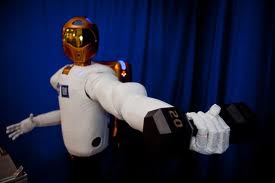
[Cross-posted on ST-AIRC blog]
NASA's R2 Robot was unveiled yesterday on board the International Space Station. The robot will assist astronauts inside the ISS, although it will still be in testing mode through the summer (testing begins in May).
For more see this article.
At the NASA site.
Friday, February 4, 2011
Bollywood's Vision of a Robotic Future
[Cross-posted on ABA ST-AIRC Blog]
Last fall, Bollywood (India's version of Hollywood; by some measures (for instance, number of films produced per year, it is larger)) released its most expensive film ever: "Robot" (or "Endhiran"). Great special effects, and -- it appears -- a "Terminator"-type story-line. Here's the official site.
Here's the official trailer:
And here's a compilation of the "best" scenes involving robots, spliced together (overdubbing is believed to be Russian):
Last fall, Bollywood (India's version of Hollywood; by some measures (for instance, number of films produced per year, it is larger)) released its most expensive film ever: "Robot" (or "Endhiran"). Great special effects, and -- it appears -- a "Terminator"-type story-line. Here's the official site.
Here's the official trailer:
And here's a compilation of the "best" scenes involving robots, spliced together (overdubbing is believed to be Russian):
Why Does Japan Emphasize Robotic Advances?
[Cross-posted on ABA ST-AIRC Blog]
From the BBC, interesting article about why Japan has taken such an active role in promoting "humanized" robots -- necessity being the mother of invention. And why some of the elderly in Japan prefer the human touch:
From the BBC, interesting article about why Japan has taken such an active role in promoting "humanized" robots -- necessity being the mother of invention. And why some of the elderly in Japan prefer the human touch:
No, Robot: Japan's Elderly Fail to Welcome Their Robot Overlords
By Michael Fitzpatrick BBC News, Tokyo
"In Japan robots are friendly helpers not Terminators. So when they join the workforce, as they do often in factories, they are sometimes welcomed on their first day with Shinto religious ceremonies.
But whether the sick and elderly will be as welcoming to robot-like tech in their homes is a question that now vexes a Japanese care industry that is struggling with a massive manpower shortage. Automated help in the home and hospitals, believe some, could be the answer. A rapidly aging first world is also paying close attention to Japan's dalliance with automated care. It wants to know whether it can construct the nursing-care and medical-care needed in a future with fewer younger people to take care of the elderly.
Japan could show us how.
"The country sees it as an imperative to build carer robots and systems that can monitor health in the home. Because without them the nation's health care system won't cope," says carer Yasuko Amahisa.
Monday, January 31, 2011
Not Exactly the Turing Test
[Cross-posted on ABA ST-AIRC Blog]
RoboCup participants are trying to build a robot with a specific purpose: to defeat the 2050 World Cup (human) champions. Here are the latest advances towards that end: Hat tip to BotJunkie:
RoboCup participants are trying to build a robot with a specific purpose: to defeat the 2050 World Cup (human) champions. Here are the latest advances towards that end: Hat tip to BotJunkie:
Monday, January 24, 2011
MIT's Sherry Turkle on the Impact of Technology on Society
From the January 14, 2011 issue of the Chronicle of Higher Education:
Programmed for Love
By Jeffrey R. Young
In a skeptical turn, the MIT ethnographer Sherry Turkle warns of the dangers of social technology "...She has spent some 15 years since that day studying this emerging breed of "sociable robots"—including toys like Furbies and new robotic pets for the elderly—and what she considers their seductive and potentially dangerous powers.
She argues that robotics' growing trend toward creating machines that act as if they were alive could lead people to place machines in roles she thinks only humans should occupy.
Her prediction: Companies will soon sell robots designed to baby-sit children, replace workers in nursing homes, and serve as companions for people with disabilities. All of which to Turkle is demeaning, "transgressive," and "damaging to our collective sense of humanity..."
Monday, December 20, 2010
Warehouse Robots Featured in WSJ
[Cross-posted with ABA ST-AIRC Blog]
Today's WSJ has a featured article on the tradeoffs for warehouses that are primarily staffed by humans, and those primarily staffed by robots. They compare and contrast a Crate & Barrel (robotic) shipment center with one run by Amazon (humans).
Today's WSJ has a featured article on the tradeoffs for warehouses that are primarily staffed by humans, and those primarily staffed by robots. They compare and contrast a Crate & Barrel (robotic) shipment center with one run by Amazon (humans).
Saturday, December 18, 2010
Wired Mag: Special Report on AI
[Cross-posted from ABA's ST-AIRC Blog]
The January issue of Wired Magazine features a special report on the use of Artificial Intelligence in various fields, from Wall Street to fraud prevention. The bottom line? "Artificial Intelligence is here. But it's nothing like we expected."
The January issue of Wired Magazine features a special report on the use of Artificial Intelligence in various fields, from Wall Street to fraud prevention. The bottom line? "Artificial Intelligence is here. But it's nothing like we expected."
Monday, November 29, 2010
Predator Drones Featured in Wikileaks
[Cross-posted from ABA's ST-AIRC Blog]
Among other tidbits in the Wikileak documents: many countries are asking for the US to sell them Predator drones.
Among other tidbits in the Wikileak documents: many countries are asking for the US to sell them Predator drones.
WikiLeaks Reveals Everybody’s Christmas List: The World Wants Drones
By Adam Rawnsley
Only a select few close American allies have the export-restricted Predator B (a.k.a. MQ-9 Reaper) armed drones, but that hasn’t stopped countries from the United Arab Emirates to Turkey from pestering & pleading with America to sell them the shiniest new toy, the WikiLeaks document show...
Sunday, November 28, 2010
DoD Studying Flying Snakes
Thursday, November 12, 2009
There's an App for That?!?!
The growing proliferation of robots (corresponding to the ubiquity of technology and/or drop(s) in prices) continues.
The latest example: as mentioned earlier, a lab at MIT has developed a application for the iPhone that allows a user to connect to a relatively cheap ($5,000 or so) quad-rotor helicopter available from Ascending Technologies GmbH.
What is key to the application is that the robot is finding 'its own way.' As demonstrated in the video, the user simply identifies an end point, and the mini-UAV (Unmanned Aerial Vehicle) plots its path to the target. (Presumably avoiding obstacles, like the vertical column seen in the video, in the process.)
The UAV is equipped with a camera, making the military applications obvious: seeing around corners, looking at the top of roofs for snipers, examining possible IEDs. But the availability of the components (and lost cost thereof) will mean that 'bad guys' will also have the technology. In addition, one could imagine civilian users who might also use the device for less-than-admirable ends.
In her talk on Tuesday, Dr. Cummings alluded to the Federal Aviation Administration's concern about these micro UAVs. Indeed, the FAA has started to issue regulations and related certificates for such UAVs: Honeywell received one of the first certificates in 2005 to test an untethered UAV on the Laguna Indian Reservation (about 45 miles from Albuquerque); interestingly, the FAA, in issuing such a certificate, evaluates the airworthiness of the entire system, not just the drone. Among the FAA's current requirements, there must be a ground observer or an accompanying “chase” aircraft must maintain visual contact with the drone, to insure that there is no interference with other aircraft. In February 2007, the FAA published medical certification requirements for pilots who are 'operating' UAVs.
This field will clearly continue to grow, and the FAAs ability to safely manage US airspace will be an ongoing challenge. Introduction of such mini UAVs in a battlefield situation (over Afghanistan or Pakistan, for example) will require coordination between various service.
(As an aside, radio-controlled (RC) model aircraft are subject to other rules, and are not supposed to be flown more than 400 feet off the ground.)
Wednesday, November 11, 2009
Wired for War Comes to Cambridge
PW Singer, author of Wired for War, spoke yesterday at MIT's Computer Science and Artificial Intelligence Laboratory (CSAIL).
Picking up on his book, Singer spoke to a full lecture hall that seemed evenly split between undergrad, grad, and faculty. He emphasized the fact that development of military robotics -- whether designed for defensive or offensive capabilities -- was outstripping (by far) legal, ethical, and scientific analysis of the impact that such new devices have on human's capacity to make war. Instead, he spoke of scientists and robotic developers who believed that such "non-scientific" concerns were not their concern, or that the developers would be able to maintain control over the robots (rather than policy-makers.)
Singer also spoke of the speed of this change, and the impact it has been having on both young soldiers (who can fly a drone over Pakistan from North Dakota, for instance, without even having a pilot's license) to senior policy-makers (whose understanding of the rate of deployment of such weapons is, at times, woefully behind the curve.)
There was some discussion of a recent New Yorker article about the Predator and Reaper (a more-heavily armed Predator) programs. The article expressed special concern about the drones operated by the CIA, which author Jane Mayer maintains, does not have the same experience or procedural limits on indiscriminate targetting as does the military. Indeed, the UN (through its Committee on Extrajudicial, Summary or Arbitrary Executions) recently demanded that the US make showing that such CIA-operated drones are within the bounds of international law.
Singer was joined on stage by MIT Professor Missy Cummings, a former Navy fighter pilot. Her work is in the field of unmanned flight, and she discussed a few of her ongoing projects(*).
(*) - More to come on this.
Finally, it is clear that in the post-9/11 era, funding for robotics and related projects will be dominated by the Defense Department. From the Navy (like Japan) studying baseball-playing robots to self-driven cars, it clear that military uses (and plain old military research) will drive this field. And as Singer noted, such research funding comes with costs.
A recording of the Forum is expected to posted online shortly at the MIT Technology and Culture site.
Picking up on his book, Singer spoke to a full lecture hall that seemed evenly split between undergrad, grad, and faculty. He emphasized the fact that development of military robotics -- whether designed for defensive or offensive capabilities -- was outstripping (by far) legal, ethical, and scientific analysis of the impact that such new devices have on human's capacity to make war. Instead, he spoke of scientists and robotic developers who believed that such "non-scientific" concerns were not their concern, or that the developers would be able to maintain control over the robots (rather than policy-makers.)
Singer also spoke of the speed of this change, and the impact it has been having on both young soldiers (who can fly a drone over Pakistan from North Dakota, for instance, without even having a pilot's license) to senior policy-makers (whose understanding of the rate of deployment of such weapons is, at times, woefully behind the curve.)
There was some discussion of a recent New Yorker article about the Predator and Reaper (a more-heavily armed Predator) programs. The article expressed special concern about the drones operated by the CIA, which author Jane Mayer maintains, does not have the same experience or procedural limits on indiscriminate targetting as does the military. Indeed, the UN (through its Committee on Extrajudicial, Summary or Arbitrary Executions) recently demanded that the US make showing that such CIA-operated drones are within the bounds of international law.
Singer was joined on stage by MIT Professor Missy Cummings, a former Navy fighter pilot. Her work is in the field of unmanned flight, and she discussed a few of her ongoing projects(*).
(*) - More to come on this.
Finally, it is clear that in the post-9/11 era, funding for robotics and related projects will be dominated by the Defense Department. From the Navy (like Japan) studying baseball-playing robots to self-driven cars, it clear that military uses (and plain old military research) will drive this field. And as Singer noted, such research funding comes with costs.
A recording of the Forum is expected to posted online shortly at the MIT Technology and Culture site.
Monday, June 15, 2009
Wired for War

"Wired for War", by P.W. Singer, is a far broader book that the title indicates (although the subtitle -- The Robotics Revolution and Conflict in the 21st Century does give some indication.) Rather than limit his inquiry into the the current state of the robotics world, Singer covers the entire gamut of how wars will be fought in the next century.
But he does spend some (first) exploring the current state of the world. He identifies two current robots: PackBot, built by iRobot; and Talon and its "pissed-off big brother" SWORDS (Special Weapons Observation Reconnaissance Detection System) built by Foster-Miller.
Singer considers himself a child of pop culture, and references to film, books, and even video games are littered throughout the text. Some of the references are direct, as when he wonders whether Star War's C-3PO will be the future shape of robots; others are more obscure. But Singer is at his best when he can merge the influence of science fiction -- from Asimov to the original Star Trek; from James Cameron (director of Terminator) to J.K. Rowling (the 'invisability cloak' described in Harry Potter is inspiring scientists today -- to show how culture influences scientists and their expectations of and for robotics.
Singer also wonders and writes about the role that robots will play in the warrior culture. Separation of the warrior from his opponent has long been a theme of technologic advance (after all, even Japanese samurai eventually acknowledged that their swords were no match for a peasant with a gun). But Singer notes that the very fact of "going to war" -- heading off to a distant place where the laws of normal society are suspended -- no longer applies when a Predator drone can be flown over Afghanistan by an operator who can finish his mission and be home in time for dinner.
The book also raises the topic related to robotics: artificial intelligence. As systems become more and more sophisticated, human oversight becomes an temporal impediment to resolving a conflict successfully. In other words, if machines are waiting for human approval of a pre-emptive attack, the opportunity will be lost, and the machine (and perhaps one or more humans) will suffer as the result. But the alternative: humans ceding control to machines without "human fail-safe" is a topic that, as Singer records, is not one very many scientists working in the field wish to discuss.
Singer does a admirable job of identifying issues that the new technology will raise. While he doesn't try to predict outcomes, he also points to a future that will continue to challenge us. The book is well-worth reading for those who are looking to quickly grasp a state of the robotics/AI world, as it applies to war-making. And in a post-9/11 environment, defense budgets and political resistance to casualties means that more, not less, resources will be available for placing machines "in harm's way."
Sunday, May 24, 2009
MSM Discovers AI
Another sign that concepts around artificial intelligence (AI) and robotics are breaking through to the mainstream media (MSM): an article by John Markoff in the NYT's Week in Review.
While Markoff does not break much new ground -- he summarizes the rise of the concepts of "Singularity" and the ethical issues that AI may raise -- TWIR is a marker on the way to reaching opinion-leaders. In the old world of newspapers and magazines, a cover story on AI/Robotics in Time or Newsweek would not be far behind.
But in the brave new world of the MSM, there's no longer a clear formula for moving from techie journals, to creeping into the Science section of the NYT, to 'breaking out' into popular culture. And the fact that it's Memorial Day weekend -- and that much of Manhattan is out in the Hamptons (or wishing they were there like last year) -- may mean that AI is not quite ready for its coming-out party.
While Markoff does not break much new ground -- he summarizes the rise of the concepts of "Singularity" and the ethical issues that AI may raise -- TWIR is a marker on the way to reaching opinion-leaders. In the old world of newspapers and magazines, a cover story on AI/Robotics in Time or Newsweek would not be far behind.
But in the brave new world of the MSM, there's no longer a clear formula for moving from techie journals, to creeping into the Science section of the NYT, to 'breaking out' into popular culture. And the fact that it's Memorial Day weekend -- and that much of Manhattan is out in the Hamptons (or wishing they were there like last year) -- may mean that AI is not quite ready for its coming-out party.
Friday, April 3, 2009
Aptly Named
The London-based Financial Times reports that a self-directed robot (called Adam) at Aberystwyth University (located in Wales) working with scientists from Cambridge University developed and conducted an experiment without human intervention.
Although the experiments were relatively simple -- involving baker's yeast -- the results, and the means of obtaining, were published in the journal Science.
The scientific team is already working a more "elegant" successor to the robot, to be named Eve.
Although the experiments were relatively simple -- involving baker's yeast -- the results, and the means of obtaining, were published in the journal Science.
The scientific team is already working a more "elegant" successor to the robot, to be named Eve.
Tuesday, March 31, 2009
Mapping the Brain
While Honda is working on mapping and interpreting 'brain waves' from outside the scalp, the Allen Institute is taking a more 'inside' approach.
As highlighted in next month's Wired Magazine, Paul Allen has sponsored a $55M, 9-year project that is expected to take until 2012: mapping the DNA sequences throughout the human brain.
Modelled on the Human Genome Project (which itself took 13 years, and was completed in 2003), the Allen Brain Atlas has developed its own robots to efficiently test and classify the 20,000 genes that comprise the average human brain.
The Allen Institute has already completed one related project: mapping the DNA of a mouse brain, located here. (Mouse brains are -- perhaps somewhat disappointingly -- are not dissimilar to human brains.)
Completion of the brain DNA sequencing may open up many possibilities to address mental illnesses and disorders, which often contain a significant genetic component. Indeed, high-profile conditions like autism and Alzheimer's (and perhaps related conditions like Chronic Traumatic Encephalopathy (CTE)) may become more treatable once the genetic codes are unlocked.
More evidence that technological advancement continues even as the world's finances remain unsettled.
As highlighted in next month's Wired Magazine, Paul Allen has sponsored a $55M, 9-year project that is expected to take until 2012: mapping the DNA sequences throughout the human brain.
Modelled on the Human Genome Project (which itself took 13 years, and was completed in 2003), the Allen Brain Atlas has developed its own robots to efficiently test and classify the 20,000 genes that comprise the average human brain.
The Allen Institute has already completed one related project: mapping the DNA of a mouse brain, located here. (Mouse brains are -- perhaps somewhat disappointingly -- are not dissimilar to human brains.)
Completion of the brain DNA sequencing may open up many possibilities to address mental illnesses and disorders, which often contain a significant genetic component. Indeed, high-profile conditions like autism and Alzheimer's (and perhaps related conditions like Chronic Traumatic Encephalopathy (CTE)) may become more treatable once the genetic codes are unlocked.
More evidence that technological advancement continues even as the world's finances remain unsettled.
Subscribe to:
Posts (Atom)