My mission at Google is to develop natural language understanding with a team and in collaboration with other researchers at Google. Search has moved beyond just finding keywords, but it still doesn’t read all these billions of web pages and book pages for semantic content. If you write a blog post, you’ve got something to say, you’re not just creating words and synonyms. We’d like the computers to actually pick up on that semantic meaning. If that happens, and I believe that it’s feasible, people could ask more complex questions.Wired Magazine article
Showing posts with label ST-AIRC. Show all posts
Showing posts with label ST-AIRC. Show all posts
Thursday, April 25, 2013
Ray Kurzweil Speaks About His Role at Google
Late last year, Google announced
that it had teamed up with AI guru Ray Kurzweil to collaborate on AI
applications both in search and elsewhere. Last week, Kurzweil hosted a
Google Hangout, and then sat for an interview with Wired Magazine. Among the highlights was his description of what he is doing for Google:


Tuesday, April 9, 2013
National Robotics Week Continues

National Robotics Week continues this week (and through April 14th, although events continue throughout the month of April.)
For more info see:
National Robotics Week website
Twitter: @roboweek
Facebook page
Tuesday, March 26, 2013
(Moisture) Farming with Droids

No word on whether any farmers will have need for a protocol droid.
Wednesday, March 20, 2013
Golf Telecasts Brought to You By...Drones

A ball striking a drone would presumably be subject to the Rules of Golf: play it as it lies.
Thursday, March 7, 2013
Senator Rand Paul Stages "Real" Filibuster Over Drone Strikes

In the wee hours of this morning, Senator Rand Paul (R-KY) ended a 12+ hour "talking" filibuster to hold up the nomination of John Brennan to be CIA Director. But the substantive reason for Paul (who was joined by a number of other Senators) was an exchange earlier in the day when Senator Ted Cruz (R-TX) questioned AG Eric Holder about the circumstances under which the President could order a drone strike on an American citizen on US soil.
Article on Rand's Filibuster
Video of Cruz-Holder Exchange
Wednesday, February 27, 2013
Drone Medal Draws Fire

Wednesday, January 23, 2013
China Gets in on the Self-Driving Boom

Joining Toyota, Google, and Audi, China's Army (PLA) announced earlier this month that it has tested its own self-driving car. Code named "Lion No. 3", the car apparently hit a top speed of 105/kmh (65 mph), and overtook 33 cars in 85 minutes in recent tests on China's roads.
Tuesday, January 22, 2013
Toyota Announces that It is Also Testing a Driver-Assisting Car -- in Michigan
Wednesday, January 16, 2013
Interacting with the Driverless Car
Alexis Madrigal of The Atlantic had an interesting "back to the future" moment when filming a demonstration of the Audi driverless-car system; he was reminded of the reaction that early 20th-century farmers had when confronting an automobile for the first time. See the video for more.
Wednesday, January 9, 2013
AI Creates Classical Music
Spanish researchers are developing a new kind of AI software that can make classical music on its own. Iamus (named after Greek god of music) uses the 12-note "Western" scale currently, but its programmers are currently adding "Eastern" (Hindu and Arab) scales, and the expectation is that the program will eventually merge the different sounds into something new.
Monday, January 7, 2013
Audi Authorized by Nevada for Driverless Car

Friday, January 4, 2013
New Information Emerges About Air France Flight 447
More than two years after the Airbus 330 crashed, new information has emerged thanks to locating and recovering the "black box" flight data recorder. In short, human error caused the crash of AF 447. But the human error was in the face of -- and in some cases, enhanced by -- advanced autopilot functions that the human pilots were relying upon. Because they trusted the Airbus to "self-correct", the inexperienced pilots continued to fly the plane in the face of stall alarms. If they had been flying a much less sophisticated vehicle, it seems unlikely that they would not have taken corrective action and avoided the catastrophe. The Popular Mechanics article shows one of the problems that can emerge when "artificial intelligence" is relied upon in the face of other empirical data.
Popular Mechanics article
Thursday, March 17, 2011
Reuters: Why no Robots in Japan's Nuke Facility?

[Cross-posted at ST-AIRC Blog)
Reuters is running a story wondering why Japan -- where robots are used much more extensively then in the US -- no robots are available to help solve the nuclear emergency at the Fukushima Dai-ichi plant.
Japan a Robot Power Everywhere Except at Nuclear Plant
By Jon Herskovitz
TOKYO, March 17 (Reuters) - Japan may build robots to play the violin, run marathons and preside over weddings, but it has not deployed any of the machines to help repair its crippled reactors.
While robots are commonplace in the nuclear power industry, with EU engineers building one that can climb walls through radioactive fields, the electric power company running Japan's Fukushima Dai-ichi plant has not deployed any for the nuclear emergency.
Instead, its skeleton team has been given the unenviable and perhaps deadly task of cooling reactors and spent nuclear fuel on their own, only taking breaks to avoid over-exposure...
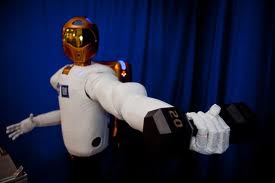
NASA's R2 Robot Unveiled
[Cross-posted on ST-AIRC blog]
NASA's R2 Robot was unveiled yesterday on board the International Space Station. The robot will assist astronauts inside the ISS, although it will still be in testing mode through the summer (testing begins in May).
For more see this article.
At the NASA site.
Tuesday, February 22, 2011
A Sampling of IBM Watson News over the Weekend
[Cross-posted on ST-AIRC Blog]
IBM has inked a deal with Nuance to apply Watson's Jeopardy-winning Deep Question Answering technology to health care.
IBM’s Watson Jeopardy Stunt Unleashes a Third Great Cycle in Computing
NY Times' Stanley Fish -- not very impressed with Watson
Stephen Baker, author of “Final Jeopardy: Man vs. Machine and the Quest to Know Everything” on the impact of IBM's Watson
TED-cast by Stephen Baker
IBM has inked a deal with Nuance to apply Watson's Jeopardy-winning Deep Question Answering technology to health care.
IBM’s Watson Jeopardy Stunt Unleashes a Third Great Cycle in Computing
NY Times' Stanley Fish -- not very impressed with Watson
Stephen Baker, author of “Final Jeopardy: Man vs. Machine and the Quest to Know Everything” on the impact of IBM's Watson
TED-cast by Stephen Baker
Friday, February 18, 2011
More Follow-up From Watson
A sampling of four new articles following upon on Watson's victory in Jeopardy!
Professor Oren Etzioni, the director of the UW Turing Center, on the match:
Watson as the beginning of a new kind of search engine?
Ken Jennings on his Watson experience:
Gary Kasparov on playing chess alongside - rather than against - a computer:
Professor Oren Etzioni, the director of the UW Turing Center, on the match:
It didn't surprise me that Watson won. In fairness there are some small things in the game that give it an advantage, like the time that it has to process -- it sees the clue instantly, it gets transmitted via text, and then it's told when it can buzz in. So it has a number of these small advantages and particularly last night it was often winning on time.
Watson as the beginning of a new kind of search engine?
Etzioni says he expects natural-language software to make a big dent in search applications over the next five years, although at the moment systems such as Watson aren't ready for 'prime time': he notes that Microsoft bought a natural-language processing company called Powerset in 2008 for US$100 million, "but you don't see Microsoft using it in any visible way". Kautz agrees that systems as broad and powerful as Watson could be available for general use "surprisingly soon. Let's say three to four years."
Ken Jennings on his Watson experience:
I expected Watson's bag of cognitive tricks to be fairly shallow, but I felt an uneasy sense of familiarity as its programmers briefed us before the big match: The computer's techniques for unraveling Jeopardy! clues sounded just like mine. That machine zeroes in on key words in a clue, then combs its memory (in Watson's case, a 15-terabyte data bank of human knowledge) for clusters of associations with those words.
Gary Kasparov on playing chess alongside - rather than against - a computer:
Having a computer partner also meant never having to worry about making a tactical blunder. The computer could project the consequences of each move we considered, pointing out possible outcomes and countermoves we might otherwise have missed. With that taken care of for us, we could concentrate on strategic planning instead of spending so much time on calculations.
Thursday, February 17, 2011
Machines 2, Humans 0

Building on its defeat (through Deep Blue) of chess master Gary Kasparov in 1997, IBM's AI team was a big winner last night with Watson storming from behind to win for the third night in a row, and dominating lead total of $77,147 for the week, more than the two humans combined. Ken Jennings finished second with a three-day total of $24,000 and Brad Rutter was third with $21,600.
Watson seemed to be off-its-game early, trailing for much of the first half of the game. But perhaps it was a machine version of "Rope-a-Dope": when "Double Jeopardy" began, Watson answered 18 of the 29 questions, ensuring its win.
Jennings finished the evening with a message as part of his "Final Jeopardy"
written answer:
"I for one welcome our new computer overlords."
Some analysis of how Watson "heard" the answers.
What Watson's victory means: Link
And an interview with IBM engineer: Link
Wednesday, February 16, 2011
Man-vs-Machine (3)
In Day Two of Man-vs-Machine Jeopardy!, IBM’s Watson dominated much of the show, answering 13 of the first 15 questions correctly and leading with $ $35,734 to $10,400 for all-time money leader Brad Rutter and just $4,800 for Ken Jennings.
In fact, but for its answer on Final Jeopardy (when it answered “Toronto” even though the category was U.S. Cities, and the clue was “Its largest airport was named for a World War II hero; its second largest, for a World War II battle.” With its answer, Watson showed the slightest bit of, um, fallibility.), Alex Trebek may have had to “stop the fight”… as it is, Jennings and Rutter will have a final chance tonight.
As they say, check local listings…
IBM’s Watson team offered this analysis of the Final Jeopardy mistake from last night. Meanwhile, IBM’s General Counsel, Robert C. Weber, offered this view of why Watson matters to the legal profession:
And here’s a PBS Newshour piece on the development of Watson, which also covers some of the history of AI:
In fact, but for its answer on Final Jeopardy (when it answered “Toronto” even though the category was U.S. Cities, and the clue was “Its largest airport was named for a World War II hero; its second largest, for a World War II battle.” With its answer, Watson showed the slightest bit of, um, fallibility.), Alex Trebek may have had to “stop the fight”… as it is, Jennings and Rutter will have a final chance tonight.
As they say, check local listings…
IBM’s Watson team offered this analysis of the Final Jeopardy mistake from last night. Meanwhile, IBM’s General Counsel, Robert C. Weber, offered this view of why Watson matters to the legal profession:
And here’s a PBS Newshour piece on the development of Watson, which also covers some of the history of AI:
Tuesday, February 15, 2011
Man-vs-Machine (2)
From an upcoming film on Uncontacted Tribes in the Amazon:
Also brings to mind a recent best-seller, "The Lost City of Z" by David Grann, about one of the last "romantic" explorers in the early part of the last century: Percy Fawcett. Fawcett, having explored much of the Amazon, left in 1925 on a search for El Dorado -- the Lost City of Gold. He, his son, and a friend disappeared into the Amazon jungle, and were never heard from again.
The book chronicles a latter-day effort to retrace Fawcett's footsteps, which brings the author all-too-close to repeating Fawcett's experiences. The result is a compelling read.

Also brings to mind a recent best-seller, "The Lost City of Z" by David Grann, about one of the last "romantic" explorers in the early part of the last century: Percy Fawcett. Fawcett, having explored much of the Amazon, left in 1925 on a search for El Dorado -- the Lost City of Gold. He, his son, and a friend disappeared into the Amazon jungle, and were never heard from again.
The book chronicles a latter-day effort to retrace Fawcett's footsteps, which brings the author all-too-close to repeating Fawcett's experiences. The result is a compelling read.

Man-vs-Machine
IBM’s Watson was tied for the lead after the first day of “Computer-vs-Human” challenge on this week’s Jeopardy, including long-time champ Ken Jennings (who has won 74 in a row).
One of the questions Watson answered correctly:
Clue: "Iron fitting on the hoof of a horse or a card-dealing box in a casino."
Watson: "What is shoe?"
But in other areas, Watson struggled:
Clue: "From the Latin for end, this is where trains can also originate."
Watson: "What is finis." Confidence level: 97%.
Trebek: "No. Ken?"
"What is terminus," Jennings answered correctly.
It will be interesting to see what the cultural impact of a Watson victory will be, especially in comparison to IBM's Deep Blue vs. Kasparov in 1997.
Watson is not connected to the Internet, and although Alex Trebek (and others) repeat that fact, it appeared that Watson did best when the answers were those that would be found by a search engine:
Computer-vs-human Jeopardy continues tonight (2/15/2011) and Wednesday (2/16/2011).
One of the questions Watson answered correctly:
Clue: "Iron fitting on the hoof of a horse or a card-dealing box in a casino."
Watson: "What is shoe?"
But in other areas, Watson struggled:
Clue: "From the Latin for end, this is where trains can also originate."
Watson: "What is finis." Confidence level: 97%.
Trebek: "No. Ken?"
"What is terminus," Jennings answered correctly.
It will be interesting to see what the cultural impact of a Watson victory will be, especially in comparison to IBM's Deep Blue vs. Kasparov in 1997.
Watson is not connected to the Internet, and although Alex Trebek (and others) repeat that fact, it appeared that Watson did best when the answers were those that would be found by a search engine:
The questions that it did best at are ones that if you entered into Google or Bing, you can get the same answers. For instance, if you input one of the questions asked in the Jeopardy! tournament into Google, "Bang, bang, his silver hammer came down upon her head" one of the first results is "Maxwell's Silver Hammer" which Watson correctly answered. You get the same results with Bing. It's as if Watson is using the same sort of search algorithms, except not culled from the Internet, but a manually compiled, ginormous database of song lyrics, history, literature and other concrete, indisputable bits of information.
Computer-vs-human Jeopardy continues tonight (2/15/2011) and Wednesday (2/16/2011).
Subscribe to:
Posts (Atom)