Back in 2007, in connection The New Republic, I put together the "Most Memorable NCAA Semifinal Games" since 1979. With four more Final Fours since that list, and with two highly-anticipated semifinals approaching on Saturday, it's time to update the list.)
(Why 1979? It’s arguably the start of the modern era, with the Bird/Magic final. (That’s still the highest rated TV game, and also – and perhaps not coincidentally -- the first college game I remember watching.))
Here's the updated list, with video (as available):
Honorable Mention:
* (#1) Georgetown 50 / (#3) Louisville 46 (1982) (Trivia: Name that game's MVP, as chosen by CBS. (Answer below))
*(#11) George Mason 58 / (#3) Florida 73 (2006)
For more on these two games, go here.
10. (#3) Michigan 83 / (#1) Illinois 81 (1989)
The 31-5 Flyin’ Illini had been near the top of the national rankings for a good part of the season, and featured future NBA first round draftees in Kendall Gill (#5 pick), Nick Anderson (#11), and Kenny Battle (#27), along with sixth man (and high school legend) Marcus Liberty. Michigan featured future NBA players such as Rumeal Robinson, Loy Vaught, and Glen Rice.
With the score tied late in a back-and-forth game, Michigan’s Terry Mills missed a long jumper, but on the weak side, Sean Higgins followed-up with 0:01 left, and “Michigan man” Steve Fisher moved to a (then) career record of 5-0; somewhere Bo Schembechler is smiling at the memory.
9. (#1) Georgetown 77 / (#1) St. John’s 59 (1985)
Although a dominating performance by the Hoyas made the result a foregone conclusion well before the final horn, the lead-up to the game was enormous. #2, and St. John’s had beaten the then-previously-undefeated Hoyas earlier in the season in the Capital (DC) Center. That win was part of a long St. John’s streak that began when Coach Lou Carnesecca wore on an ‘ugly Italian sweater’ that became his trademark.
In late February, on the Hoyas’ return trip to Madison Square Garden, Georgetown coach John Thompson put on a replica of Carnesecca’s sweater under his suit coat, and opened it up to the crowd just before tipoff; the Hoyas won that night, as well.
Interesting sidenote: the Big East had placed three teams in the Final Four in 1985 (Georgetown, St. John’s, and Villanova), a feat not since equaled.
8. NEW (#5) Butler 52 / (#5) Michigan State 50 (2010)
While the clock struck midnight for George Mason in the 2006 National Semifinal, but mid-major Butler just kept rolling along. Indeed, Butler's bubble would not burst until after the final horn on Monday night.
The "patron saint of analytical coaches" Brad Stevens earned his stat-geek stripes in the last minute of this one, electing to foul Korie Lucious -- despite the presence of hundreds of college coaches in the gym, ready to second guess that decision -- with a 3-point lead.
Top-ten draft pick Gordon Hayward secured the rebound and Butler's place in NCAA history. (Of course, Butler center Matt Howard's place in fashion history had long been immortalized.)
7. (#2) UConn 79 / (#1) Duke 78 (2004)
UConn jumped on Duke early, racing to a 15-4 lead. But the Blue Devils clawed back and eventually took an (seemingly) insurmountable lead of 75-67 lead with just 3 minutes left.
But to the horror of the Dookies everywhere, UConn went on final 12-0 run to drive a dull, splintery, wooden stake – metaphorically, of course – through Duke Nation’s collective heart.
6. (#1) Indiana 97 / (#1) UNLV 93 (1987)
Despite having one of the best shooters in the game (Steve Alford), Indiana Coach Bob Knight had been a vocal opponent of the 3-point line, which was introduced that year. No one adapted faster to the new rule faster than UNLV (37-1 going into the game), and the Rebels hoisted 35 threes in the semis, including 10-for-19 from guard Freddie Banks (38 points). Armon Gilliam added 32, despite facing double-teams (Indiana essentially left UNLV guard Mark Wade unguarded, as he was a poor shooter); Wade, to his credit, handed out 18 assists, a tournament record.
Indiana only took four three-pointers, all by Alford (2-4, on his way to 33 points), and received unexpected help off the bench from a well-coiffed Steve Eyl. After the game Knight was unrepentant: "This game was a classic example of how much influence shooting now has on the game because they got 13 three-pointers and that was worth an extra 13 points. I believe basketball should involve passing and a lot of other things, not just coming down the court and throwing it in."
Trivia Answer: Freddie Brown was the 1982 MVP (as chosen by CBS) for Georgetown in the 1982 semifinal game. His 15 minutes of fame lasted just 48 hours.
(Numbers 1-5 coming tomorrow.)
Tuesday, March 29, 2011


Tuesday, March 22, 2011
The Big East's Downward Trajectory
Big-East haters, including Charles Barkley, have been having a field day over the past two days. After receiving a record 11 bids (albeit to an expanded 68-team field), the Big East has gone quietly, with just 2 of its teams (#3-seed UConn and #11-seed Marquette) surviving the first weekend to make it to the Sweet Sixteen.
And while the 11 bids may have been deserved -- perhaps most convincingly because of the general mediocrity in the rest of what became the #1-seeds(*) in the NIT field -- the BE performance has been bad. And it's part of a pattern.
(*-The NIT #1 seeds, which presumably were the "last four out" of the NCAA field -- as the NCAA now owns the NIT -- were: Alabama (21-11, #45 on KenPom, Boston College (20-12, #69), Colorado (21-13, #56), and Virginia Tech (21-11, #32.))
A year ago, the Big East sent 8 teams, which led all conferences. While West Virginia did make it all the way to the Final Four, the rest of the league did not do particularly well: only 2 teams made it to the Sweet Sixteen (WVU and Syracuse, who was beaten by eventual national runner-up Butler.)
In 2009, however, it was a better story: just 7 Big East teams (nonetheless tied with the ACC and Big Ten for most by a single conference), with 5 advancing to the Sweet Sixteen; both UConn and Villanova went to the Final Four, and but-for a tremendous defensive performance by Michigan State (throttling Louisville), the Big East may have matched its record(*) of sending 3 of the 4 teams to the Final Four.
(*-Culminating in one of greatest Finals ever, Villanova over Georgetown. St. John's also went; the other team: a Dana Kirk-coached Memphis State (nee Memphis.))
The lesson? The Big East may have become "too" good. The competition among the various programs to reach the elite level -- to be an at-large Tourney selection -- has meant that many of the programs have upgraded their coaching and commitment (most notably, St Johns this year, which went 21-12 after playing .500 over the past two years.)
With eleven legitimate Tournament teams, almost every game in the Conference was played at a high level. And the wear-and-tear may have produced entertaining league games (and a memorable Big East Tournament) but a wash-out on the game's biggest stage.
Thursday, March 17, 2011
Reuters: Why no Robots in Japan's Nuke Facility?

[Cross-posted at ST-AIRC Blog)
Reuters is running a story wondering why Japan -- where robots are used much more extensively then in the US -- no robots are available to help solve the nuclear emergency at the Fukushima Dai-ichi plant.
Japan a Robot Power Everywhere Except at Nuclear Plant
By Jon Herskovitz
TOKYO, March 17 (Reuters) - Japan may build robots to play the violin, run marathons and preside over weddings, but it has not deployed any of the machines to help repair its crippled reactors.
While robots are commonplace in the nuclear power industry, with EU engineers building one that can climb walls through radioactive fields, the electric power company running Japan's Fukushima Dai-ichi plant has not deployed any for the nuclear emergency.
Instead, its skeleton team has been given the unenviable and perhaps deadly task of cooling reactors and spent nuclear fuel on their own, only taking breaks to avoid over-exposure...
Christmas in March
There's plenty to be depressed about around the world.
Japan. Bahrain. Libya. The Deficit. The Economy.
And here in New England, the winter has been one of the snowiest and longest in recent memory.
Yet, with the dawn of the "real" opening day(*) of the NCAA Tournament -- and on St. Patrick's Day, no less -- it's truly Christmas in March, at least for those of us who love basketball.
(*-The NCAA's "First Four" notwithstanding. In reality, most people (and more importantly, most bracket pools) have ignored the four games played over the past two nights.)
The tournament has changed over the years. When I was in grade school, there was no "Selection Show", no ubiquitous printable brackets. On the Thursday of the first week, Sports Illustrated would arrive with a stapled-in insert (often sponsored by Camel Cigarettes) with my first look at the bracket as a whole. (The Springfield Union-News would publish the matchups in agate type, with the Second Round indicated only as "Saturday, 2pm: Game #7 Winner vs. Game #8 Winner")
But I would race home breathlessly after school, flip on a nascent ESPN (cable had arrived the year before, and ESPN was one of the 13 channels that were included) and watch Reggie Lewis lead a Jim Calhoun-coached Northeastern squad against LIU. Like Opening Day of a baseball season, there's no substitute for watching real-live sports in the afternoon -- and in a game that matters.
Over the years, I was lucky enough to be a small part of three First Round weeks: in 1989, 1990, and 1991. The memories of those weeks -- and in particular the "what-might-have-been" at the end of each of those games, decided by a total of 7 points -- will be with me as long as I live.
But what is most interesting is not that the memories of the Tournament would stick with me -- a role player on a mid- or perhaps low-major team. Even Kenny Anderson, a high school phenom, #2 overall pick in the NBA draft, and who played 858 games(*) in the Association -- thinks back fondly on his days in his only NCAA Tourney. And it's nice to see a player like Wisconsin's Jordan Taylor -- a player whose NBA prospects are not at all certain -- be able to reflect on the tourney even as it happens: "This is one of the best times of the year. Probably better than Christmas for a lot of us."
(*-If you don't think 858 games in the NBA is a lot, check out the all-time list. If you are even a casual sports fan, you will recognize the vast majority of the names above Kenny (for sure once you get above 1,000 or so), and you can probably bring an image of each player on that list.)
Of course, what really makes today is our discovery of Cinderella: the unheralded small school that can take down a Major. It happens every year -- almost -- but even still some are more amazing then others. In 1996, Princeton took out the defending NCAA champs in a nail-biter; Sean Gregory (also a former Tiger player) wrote a terrific retrospective in Time Magazine about the inside story-behind-the-story.
So enjoy today. And tomorrow.
By Sunday evening, the clock will probably have struck midnight for all of the Cinderellas, and we'll be (most likely) back to the BCS heavyweights for the Sweet 16. You know, the ones you've projected in your pool.
But for now, hope springs eternal. And unlike baseball, you only have to wait 40 minutes -- not 162 games -- to see it rewarded.
NASA's R2 Robot Unveiled
[Cross-posted on ST-AIRC blog]
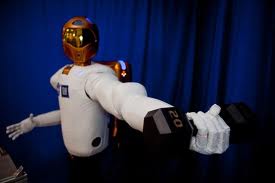
NASA's R2 Robot was unveiled yesterday on board the International Space Station. The robot will assist astronauts inside the ISS, although it will still be in testing mode through the summer (testing begins in May).
For more see this article.
At the NASA site.
Subscribe to:
Posts (Atom)